A No-Jargon Guide to Wheel Materials
Pushing a cart with the wrong wheels is one of those things you notice every single day. It’s too hard to roll, too loud on the floor, or too soft to carry the load. The good news is that choosing the right wheel comes down to a few simple questions.
Hard or Soft? Start Here
Every wheel is a trade-off between two things: protecting what’s underneath it, and how easily it rolls. Softer treads cushion shock and are gentle on floors, but on a smooth floor they take more effort to push. Harder wheels roll easily and carry more weight, but they’re louder and less forgiving on the floor. Some materials can also flatten over time under a heavy, stationary load.
The right balance depends on your floor, your load, and how often the equipment moves, so it’s worth thinking it through before you buy.
The Common Wheel Materials
Here’s a quick tour of what you’ll see most often, from the softer end to the harder end:
- Rubber — solid rubber on a cast steel centre, or a pneumatic (air) tire on a steel rim. Handles shock and rough surfaces well, runs quietly, and is easy on floors. The trade-off is more rolling effort and a lower load rating than harder materials.
- Neoprene — a black, rubber-type material that’s non-marking and quiet.
- Urethane — on a plastic, nylon, or cast centre core. Quiet, non-marking, and tough against abrasion, which makes it a good-value all-rounder for warehouses, offices, and institutions.
- Elastomer — hard, with no heat build-up. Good for tow-line applications.
- Plastic — mostly smaller twin wheels, good for light-weight applications.
- Nylon — mostly used in the food industry. Cast nylon is a good higher-capacity wheel. Like most hard wheels, it is noisy and can mark finished floors.
- Phenolic — hard, and good value for money at high weight capacities. Rolls easily and tolerates heat, but it doesn’t absorb impact.
- Steel — the highest weight capacity. A good fit where floor protection isn’t a factor, and not one to put on a finished floor.
Need to handle heat? Casterland also carries high-temperature options in hi-temp phenolic and hi-temp epoxy resin.
Quick rule of thumb: if protecting the floor matters, look at the quieter, non-marking materials like neoprene and urethane. If you need to carry the most weight and the floor isn’t a concern, look at steel. Most of the other materials sit somewhere in between.
Not sure which material suits your application? Ask a Casterland specialist and they’ll point you to the right one.
Durometer: What That Number Means
Durometer is a measure of how hard a wheel material is. More precisely, it’s the material’s resistance to permanent indentation. It’s marked in the product specifications for each item, and it’s most useful for rubber and urethane treads, where it’s usually given on the Shore A scale. A lower number means a softer tread: around 75A is soft and absorbs shock, while 95A and up is hard and rolls with much less effort.
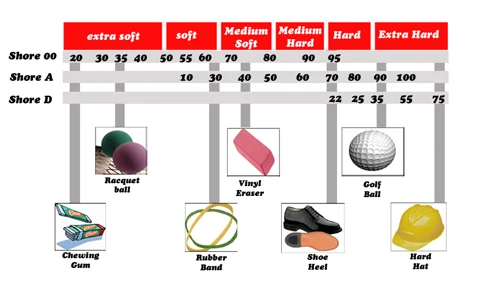
If you’re not sure whether a material is suitable for your application, give one of our experts a call.
Don’t Skip the Bore and Bearing Size
Check what bore and bearing size you need. If the standard one shown on the listing isn’t right for you, let the team know and they’ll swap it out for the correct size.
Wheel Sizes and Weight Classes at a Glance
| Shop by | Options |
|---|---|
| Wheel diameter | 2″, 3″, 4″, 5″, 6″, 8″, 10″, 12″, 14″, 16″, and 125mm |
| Light weight wheels | Up to 150 lbs |
| Medium weight wheels | 150 lbs to 1,000 lbs |
| Heavy weight wheels | Over 1,000 lbs |
| High capacity wheels | Over 3,500 lbs |
Bigger wheels also roll more easily over bumps and gaps, so if a cart feels like a chore to push, going up a diameter can help as much as changing the material.
Ready to Find Yours?
You now know the main materials, what durometer tells you, and what to check on the bore. Think about what the wheel needs to carry, what floor it rolls on, and how hard or soft it should be, and you’re most of the way there. If you want a second opinion, Casterland and its sister brand, Caster Town, can match the right wheel to your job. Shop caster wheels by material, diameter, and weight capacity at Casterland, or reach out to the team directly.